Honest Flavor. How This UK Startup Is Banking on Transparency in the MSG Wars
There's a peculiar kind of dishonesty baked into modern food marketing, the kind that whispers in ingredient lists while shouting on the front of the package.
You know the type: a company plasters "No MSG Added" across the front while the back of the label quietly lists "yeast extract," "hydrolyzed vegetable protein," "mushroom concentrate," or "natural flavors." These are all functionally delivering the same thing, free glutamate, the molecule we call MSG. Same taste. Different story.
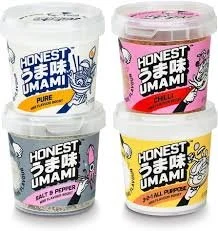
In the UK, a small startup called Honest Umami decided it was sick of this game.
The Problem with Playing Hide and Seek with Your Ingredients
According to my research on umami, MSG, and the global flavor economy, this semantic double game is neither accidental nor new. For decades, food manufacturers have exploited regulatory loopholes and cultural anxieties to have their umami and hide it too.
Here's how it works:
In the West, adding pure MSG requires explicit labeling (E621 in Europe, "MSG" in the US), triggering the stigma that lingers from decades of xenophobic "Chinese Restaurant Syndrome" misinformation.
So companies do an end-run: they switch to "natural" glutamate sources (fermented yeast, mushrooms, tomato extracts) which deliver the exact same chemistry but under friendlier legal and rhetorical cover.
The result? Consumers believe they're avoiding MSG while consuming significant amounts of it every day. And food companies get to claim both the functional benefit of umami and the moral high ground of "no artificial additives."
It's clever. It's also cynical.
Enter Rob Miller, co-founder of Honest Umami.
Radical Transparency as Rebellion
When Miller noticed that virtually every food company in the world was using MSG while publicly running away from it, he decided to do something almost absurdly simple: sell MSG as MSG, and market it unapologetically.
The brand's positioning is disarmingly straightforward:

Pure MSG in small pinch jars (not bulk industrial containers), designed to live on the kitchen counter next to salt and pepper.
Labels that say exactly what they are: "100% MSG" or "MSG Flavor Boost with Himalayan Pink Salt and Black Pepper."
Marketing that laughs at the hypocrisy: the very name "Honest Umami" is a wink to the fact that other products tout "umami" while concealing MSG.
What's remarkable is that this approach—straightforward honesty in an industry built on euphemism—is working. Honest Umami secured listings on Ocado (a premium UK grocer), engaged influencers, and built a following among food enthusiasts who appreciate the transparency.
The lesson isn't just for a niche UK brand. It speaks to a much larger shift happening in the umami market.
The Shift from "No MSG" to "Know MSG"
In my comprehensive analysis of umami marketing, I traced how major corporations are abandoning "No MSG" messaging and embracing umami education instead. Ajinomoto, the global MSG producer, launched #KnowMSG and #CancelPizza campaigns precisely to reclaim the narrative from decades of fear-mongering.
But here's the difference: corporate campaigns still come with institutional baggage. Ajinomoto is, after all, the company that makes MSG. Their transparency is valuable, but it's also strategic.
Honest Umami is different. It's a tiny startup with nothing to lose and everything to gain by calling out an entire industry for lying.
This is what marketers call "credibility through candor." In a world saturated with pseudo-health claims and green-washing, a brand that says "this is MSG and it's good" stands out precisely because it's true and because it doesn't need to hide.
What Honest Umami Reveals About Consumer Values
The rise of Honest Umami tells us something important about what modern eaters (especially younger ones) actually value:
They can smell bullshit. Millennials and Gen Z grew up watching corporations market "natural" products that were chemically identical to their "unnatural" predecessors. They're tired of it.
They want alignment between words and actions. If a company says "clean label" while loading the product with hidden glutamate under vague names, that's cognitive dissonance. If a company owns what it's doing, that's integrity.
They appreciate cultural respect. Part of Honest Umami's appeal is that it's not pretending umami is a trendy Western invention. It's acknowledging that glutamate-rich seasonings have been central to Asian, African, and Latin American cuisines for centuries, and they deserve to be celebrated, not hidden.
The Broader Implication: Transparency as Competitive Advantage
For larger food companies, the Honest Umami phenomenon is a warning and an opportunity.
The warning: "No MSG" claims are declining rapidly. According to Innova Market Insights data I cite in my broader research, products with this claim dropped 50% from 2018 to 2025. Hanging onto this messaging is looking increasingly outdated and suspect.
The opportunity: brands that move first toward transparent MSG/umami messaging can position themselves as honest players in a market drowning in euphemisms. It's an easy way to win trust with consumers who are exhausted by corporate doublespeak.
Imagine if Campbell's soups or Maggi bouillon cubes started explicitly celebrating the MSG in their products, explaining why it's safe, and connecting it to the cultural traditions that pioneered umami in the first place. They'd stand out not as reckless corporations, but as companies willing to tell the truth.
The Real Issue Was Never the Molecule, It Was the Racism
This is where Honest Umami's transparency becomes quietly radical. By selling MSG openly and celebrating it, they're not just selling a seasoning. They're challenging a narrative born in xenophobia.
The "Chinese Restaurant Syndrome" panic of the 1960s–70s wasn't rooted in science. It was rooted in fear of Chinese immigration, coded as scientific concern. Italian restaurants serving parmesan-laden dishes experienced no such panic. American processed food companies using MSG in soups and snacks faced no public outcry. Only Chinese takeout restaurants had to post "No MSG" signs to reassure (white) customers.
When Honest Umami sells MSG proudly, they're doing something politically significant: they're refusing the original xenophobic script. They're saying umami is good, MSG is good, and the cultures that built the world's umami traditions deserve credit, not suspicion.
Read more on this history in my deep dive on how racism shaped MSG's Western reputation.
Bottom Line: Honesty Isn't Just Ethical, It's Smart Marketing

Honest Umami won't replace industrial MSG manufacturers. But it's teaching the food industry something important: in a world of information abundance and skepticism, lying through loopholes doesn't scale anymore.
The brands that will win in the umami economy aren't those hiding glutamate under polite names. They're the ones willing to say: "Yes, this is MSG. Yes, it's safe.
Yes, it's delicious. And yes, it comes from traditions that deserve respect."
That's the future of flavor.
