The Christmas Market: What Seasonal Food Spaces Teach Us About Belonging
It was one of those crisp evenings where the air feels clean.
Not freezing. Not harsh. Just brisk enough to make you pull your scarf closer and feel grateful for warmth waiting somewhere, inside a café, inside a pocket, inside a cup.
I walked toward the river and immediately noticed how different the space felt.
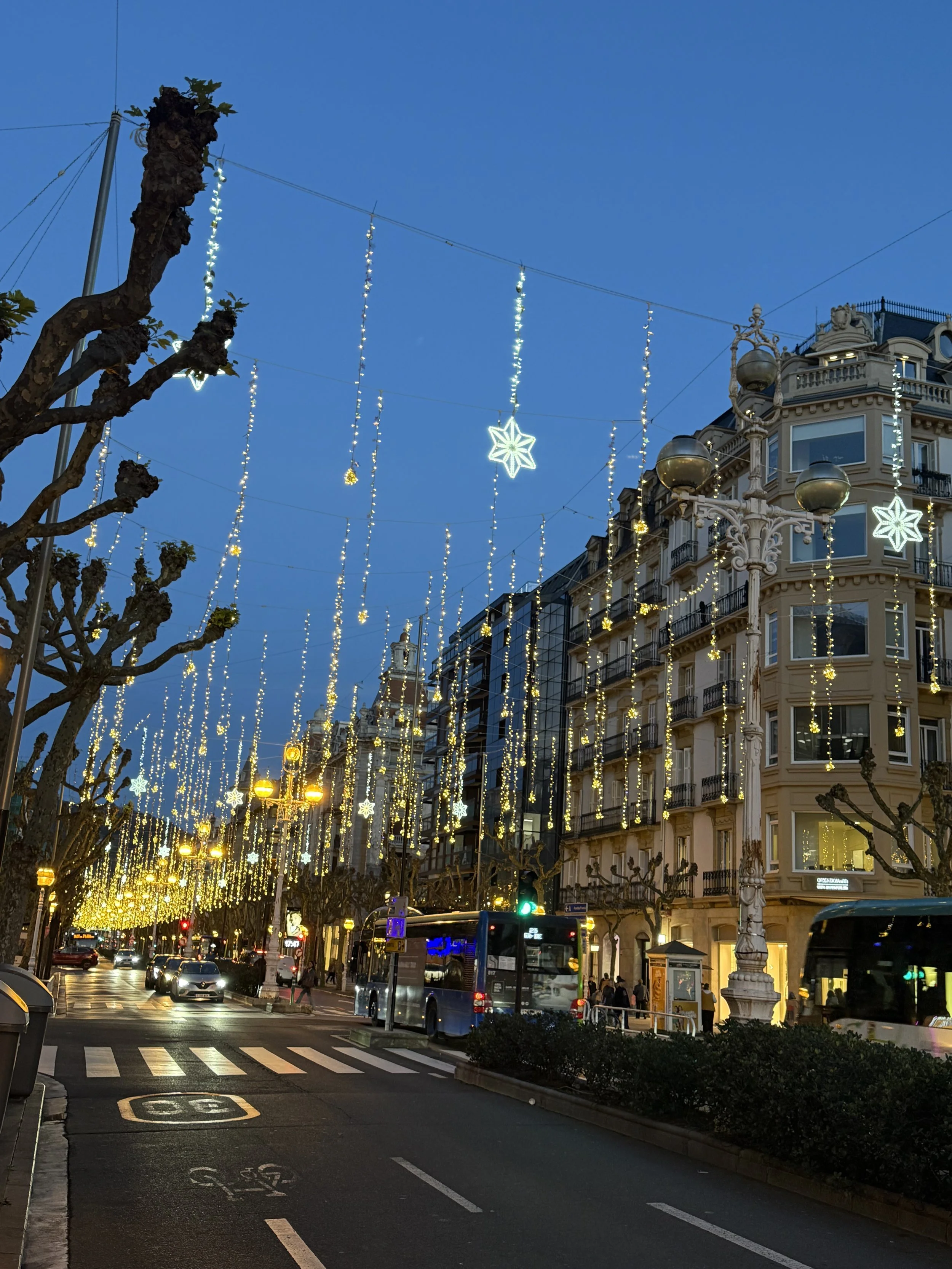
The lights were doing most of the work: warm, glowing, softening the edges of everything. Christmas music played loud enough to be unavoidable. Kids were laughing. Families were out together. Couples walked slowly, holding hands like it was their job.
And then there were the smells.
Roasted chestnuts, sweet and earthy. Cider, sharp and bright. Something fried, churros probably, because churros announce themselves from a mile away.
This part of the riverwalk is usually about movement. Walking to class. Crossing a bridge. Passing through.
But the Christmas market remade it into something else. A place designed for lingering. A place designed for warmth.
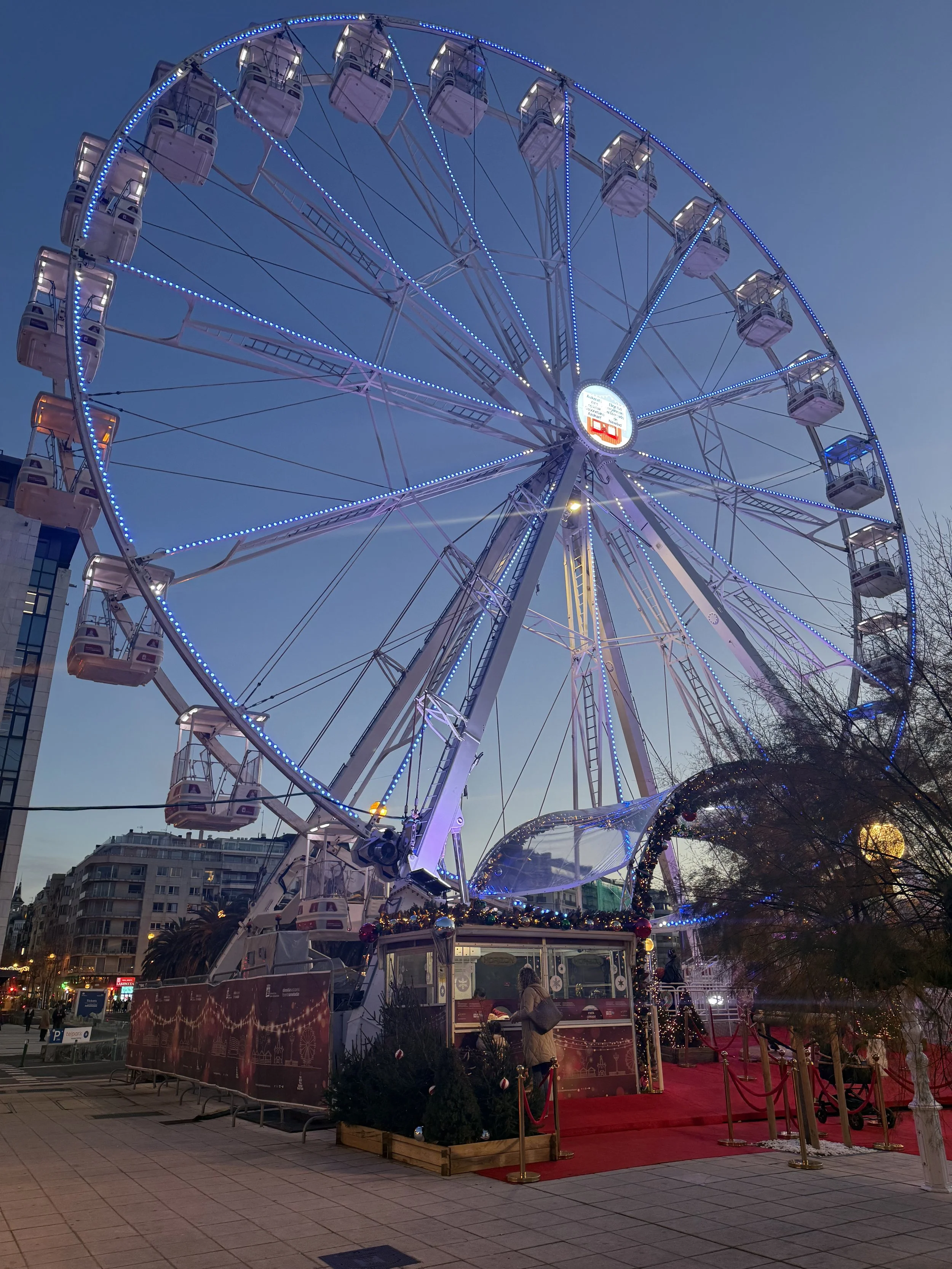
A temporary world on the Urumea
Donostia’s Christmas market is not a tiny corner stall situation. It is a whole seasonal installation, organized by the city, running from late November through early January.
In the 2025 and 2026 season, it runs from November 28 through January 6, centered along Paseo del Urumea and Plaza Ramón Labayen.
The official listing gives the daily hours as 10:30 AM to 2:00 PM, and 4:30 PM to 8:30 PM. San Sebastián Turismo
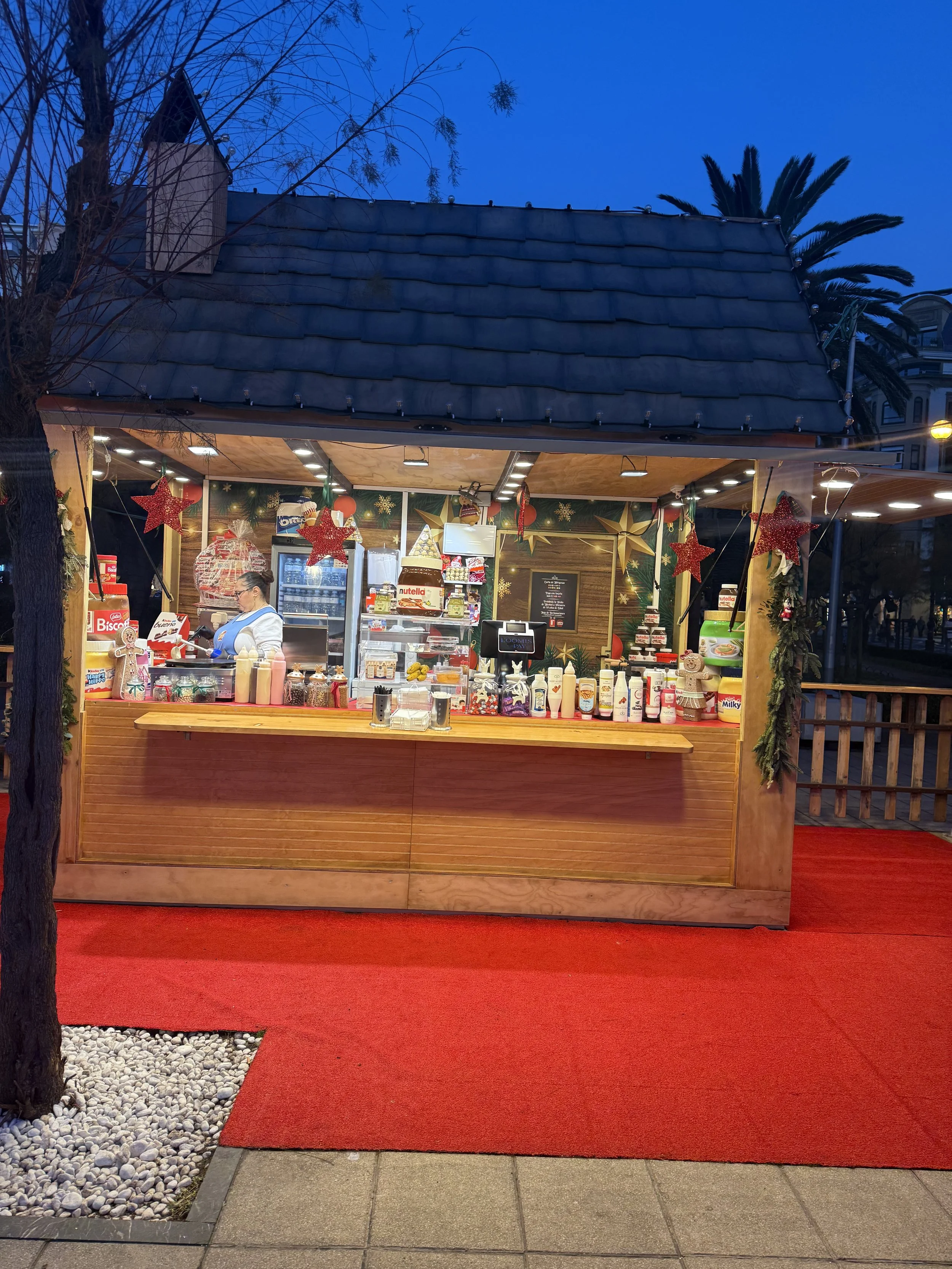
The organizer materials add a layer of scale: 37 stalls along Paseo del Urumea, 21 stalls at Plaza Ramón Labayen, and a dedicated Mercado Gastro with 13 food focused stalls plus a pergola where you can sit and eat. Donostiako Gabonetako Azoka
This is also why it feels so alive. It is not only shopping, it is a public winter room. Plaza Ramón Labayen even includes a small stage for concerts, demonstrations, and workshops, which gives the market a pulse beyond consumption.
On paper, these are logistical details.
In your body, they create a temporary world.
One where you are allowed to slow down. One where the cold becomes part of the charm because there is always something warm nearby.
What seasonal markets do to our nervous systems
I think this is one of the most underrated things about markets: they change how we move.
In everyday life, food spaces are functional. You go to the grocery store to complete a task. You grab coffee to wake up. You eat lunch because your body needs fuel.
Seasonal markets invite a different rhythm. They make food less about necessity and more about emotion. Less about efficiency and more about presence. They turn a walk into an experience. They turn buying into lingering.
And in a city like San Sebastián, where daily life already has a serious relationship with food, the holiday market adds another layer: food as celebration, food as memory, food as comfort.
A very short history of Christmas markets
It is easy to treat Christmas markets as a modern, aesthetic trend, but their roots are old.
Many historians trace them to the late Middle Ages in German speaking Europe, where winter markets helped people stock up on food and necessities as the season turned cold.
One of the oldest often cited examples is Dresden’s Striezelmarkt, first recorded in the fifteenth century.
The point was never only shopping. The point was survival plus social life. Winter is darker. Winter is harder.
So communities created structured opportunities to gather, trade, eat something warm, and feel less alone.
That is why the format works so well, even now, even in cities far from Germany, even in a place with its own strong traditions.
It is a cultural technology for getting through winter.
What this market says about San Sebastián
Every market reflects the place it lives in.
Donostia’s market sits right on the line between local identity and global tourism. You can feel it in the mix. Some stalls felt rooted: regional products, familiar flavors, things that made sense in this place. Other stalls felt more generic: gifts and holiday objects that could belong to many cities.
I do not say that as a complaint. I say it as observation. Because it is honest.
San Sebastián protects its identity. San Sebastián also participates in a global visitor economy.
Both are true.
And the market holds that tension quietly, in the way the river holds reflections: local light and imported light, side by side.
I also noticed the Basque Christmas layer tucked inside the stalls, little reminders that the holidays here are not only imported. In the Basque Country, Olentzero and Mari Domingi are the figures who announce Christmas and bring sweets and gifts for children around Christmas Eve. Euskadi Turismo
Being new here, I am still learning the choreography of these traditions. But seeing Olentzero stockings and Basque names alongside the more universal holiday glitter made the whole place feel more grounded, like the market was saying: yes, we are part of Europe, and also we are ourselves.
Food, seasonality, and cultural permission
The food offerings made perfect sense for this time of year.
Warm things. Sweet things. Fried things. Things you can hold while you walk.
Roasted chestnuts show up in winter across Europe for a reason. They smell like nostalgia even if you do not have childhood memories attached to them.
Hot drinks like mulled wine and cider make the cold feel like part of the experience rather than an obstacle.
Churros are fried comfort, indulgence made socially acceptable by the season.
That is one of the most interesting parts of holiday food culture:
There is cultural permission to indulge. Most of modern life asks us to control, optimize, restrain. Eat well. Perform discipline. Perform wellness. Seasonal rituals create sanctioned softness. They say: it is okay to want warmth and sweetness.
It is okay to eat for comfort. It is okay to let food be emotional.
From a food systems lens, that matters because it reveals something deeper:
We do not just eat to survive. We eat to feel. And winter makes that undeniable.
Consumption and care can live in the same place
Holiday markets sit right on the edge of something complicated.
They can be beautiful community spaces. They can also be consumer traps. They can be both at once.
As I walked through, I noticed myself asking small questions: Are people here to buy things, or to be together? Are the vendors supported, or squeezed? Does the market build local resilience, or only seasonal profit? How much of this is care, and how much of it is performance?
I do not ask these questions to ruin the magic. I ask because I am learning to see food spaces as systems.And systems always contain values.The best version of a market is one where people feel cared for.
Where local makers can sustain themselves. Where the space creates belonging. Where food becomes a bridge.
This market felt closer to that version for me. Not perfect. But closer.
The personal layer: being far from home
This is my first holiday season here. I am not going to pretend that does not land in my chest.
There are moments when I feel more than fine. Excited. Alive. Proud of myself for building a new life.
And then there are moments when I feel the ache of distance. This year I do not get to see my mom.That sentence does not need decoration. It is just true.
When you are far from home during the holidays, the world gets sharper. You notice families more. You notice traditions more. You notice what you are missing more.
But here is what surprised me:
At the Christmas market, I felt like I belonged. Not because anyone knew me. Because the structure of the space held me.
Seasonal rituals are designed to include strangers. They make you feel part of something even if you do not have history in the place yet.
I stood there with the smell of chestnuts and cider in the air, music everywhere, people laughing, and I felt a small thread of connection.
Food substitutes for familiarity in moments like this. Not in a shallow way. In a deep, human way. Food says: you are allowed to be here. Food says: you can take warmth from this place too. Food says: belonging can be built.
Why temporary food spaces deserve serious attention
It is easy to call holiday markets cute, but from a gastronomy lens, they are fascinating. They show us how temporary food spaces reshape movement and mood. They show us how seasonality influences craving. They show us how culture uses food to regulate emotion. They show us how cities manufacture belonging through shared rituals. They show us how commerce and care overlap in public life. Seasonal markets are like pop up laboratories for human need.
They reveal what people reach for when the days get short: warmth, sweetness, light, community, tradition.
That is not trivial. That’s the whole point.
Practical note if you want to visit the Donostia Christmas market
If you want to plan a visit, the official listing includes dates, locations, and daily hours. San Sebastián Turismo
The organizer site also includes stall counts plus an interactive map and themed walking routes for the market, lights, and attractions, which is especially helpful if you want to make it a real evening walk rather than just wandering. Donostiako Gabonetako Azoka
Additional readings:
San Sebastián Turismo, Christmas Market 2025 and 2026 listing
Official market site, Donostiako Gabonetako Azoka
Tourism Euskadi, Olentzero and Mari Domingi
Smithsonian Magazine, brief history of Christmas markets
National Geographic, history and evolution of German Christmas markets
